• Skip to primary navigation
  • Skip to main content
  • Skip to footer
Eco-Justice Connection

Eco-Justice Connection

An initiative of the North Carolina Council of Churches

Get Involved Donate
  • About
    • Mission / Goals
    • Partnerships & Collaboratives
    • History / Timeline
  • Voices
  • Initiatives
    • Faithful Advocacy
    • Climate & Energy
    • Environmental Justice
    • Local to Global
    • Climate & Health
    • Resiliency and Restoration
  • Resources
  • NCCC

Search Eco-Justice Connection

EJC Voices

Toxic Atlantic Coast Pipeline Advances

July 25, 2017 By chris

One of the final remaining hurdles for the Atlantic Coast Pipeline, approval from the Federal Energy Regulatory Commission, was cleared Friday after FERC released a positive Environmental Impact Statement. The pipeline, […]

Toxic Atlantic Coast Pipeline Advances

July 25, 2017 by chris

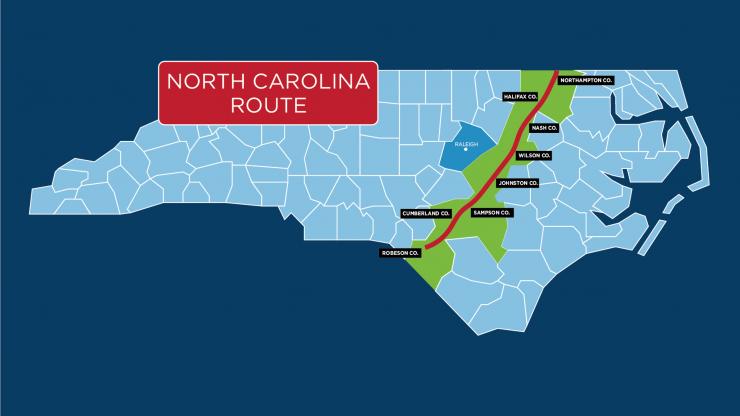
One of the final remaining hurdles for the Atlantic Coast Pipeline, approval from the Federal Energy Regulatory Commission, was cleared Friday after FERC released a positive Environmental Impact Statement. The pipeline, if approved, would originate in the heavily fracked Marcellus Shale in West Virginia. The proposed route runs south through eight N.C. counties – Northampton, Halifax, Nash, Wilson, Johnston, Sampson, Cumberland and Robeson. The N.C. Department of Environmental Quality now has to measure the project’s impact on the 453 acres of wetlands and 326 streams and rivers the pipeline crosses in the state. A permitting decision is expected Sept. 18.
Advocates of the pipeline call it a “vitally important infrastructure project that will provide energy for the region’s booming economic growth, new jobs and tax revenues for poor areas, and a cleaner-burning fuel alternative to coal”. (News & Observer, 21 July 2017)  In contrast, opponents of the pipeline say the environmental consequences are much too severe and the project rationale too weak for the DEQ to approve the permit. “It’s a huge impact on the waters and wetlands in Eastern North Carolina, and the way these pipelines are often permitted, these impacts just aren’t considered,” said Geoff Gisler, a senior attorney at the Southern Environmental Law Center.  Aaron Ruby, a Dominion spokesman, calls opposition groups “a vocal minority.” But pipeline opponents were in the majority at the DEQ hearing on Thursday in Rocky Mount. Opponents were in full gear wearing red protest signs and presenting a long list of environmental and ethical concerns.

In November of 2016, both Reverend Doctor Jennifer Copeland and Susannah Tuttle, the Executive Director of NC Council of Churches and the Director of NC Interfaith Power & Light respectively, spoke at a Fayetteville press conference passionately stating their opposition to the construction of the Atlantic Coast Pipeline. A quote from Reverend Copeland’s statement to the press:

“When I know that methane—the element that leaks from natural gas pipelines—is 84 times more detrimental to the atmosphere than carbon dioxide, I must make a choice. When I know that fracking—the method used to obtain the natural gas that will flow through this pipeline—causes irreparable damage to drinking water and creates seismic instability, I must make a choice. When I know that pipelines cut through pristine landscapes and across tribal lands, I must make a choice. I can keep doing what I’m doing, for sure, but now I know that what I am doing is an affront to creation, a violation of the gift of creation.”

A quote from Susannah Tuttle’s statement to the press:

“Pipelines connect and we DO so deeply need to be connected to each other. We need pipelines of solidarity that remind us that the hopes and dreams of all the families that are on the path of this pipeline are not so different than the hopes and dreams that we have and of the hopes and dreams of people around the globe on the front lines of climate change.

But this Atlantic Coast Pipeline is not the pipeline that we need. We need pipelines carrying ingenuity to bring us new solutions for getting our electricity from sun & wind, to produce clean energy from heaven instead of dirty energy from hell.

This Atlantic Coast Pipeline is not the pipeline that we need.  We need pipelines to bring us an expanded consciousness to see that we are deeply connected to the entire ecosystem, to the plants and to the animals, to see that what we do to our natural world will touch us too, and soon.”

In Pennsylvania, a group of resolute nuns have used a different tactic to delay the construction of their state’s threat, the Atlantic Sunrise Pipeline. This past month, an open-air chapel set up by the Catholic nuns to block construction of the natural gas pipeline was dedicated on a spot directly in the pipeline’s proposed path. The ceremony, hosted by grass-roots opposition group Lancaster Against Pipelines, is called “Stand With the Sisters” and is in support of the Adorers of the Blood of Christ, a Catholic order of women in opposition to the pipeline.
The Adorers own the land that the Atlantic Sunrise pipeline would cross. “It’s not about money, it’s about principle. And the nuns have a land ethic that says this Earth is a sanctuary and we regard it as sacred, and we’re going to work to protect it,” Mark Clatterbuck of the Lancaster Against Pipelines group told CNN affiliate WGAL-TV.

TAKE ACTION

The N.C. Department of Environmental Quality Division of Water Resources is accepting public comments on the Atlantic Coast Pipeline, now through 5 p.m. Aug. 19.

Send written comments to: 401 Permitting, 1617 Mail Service Center, Raleigh, N.C., 27699. Written comments may also be submitted by email to PublicComments@ncdenr.gov. Be sure to include “ACP” in the email’s subject line.

To learn more about the DEQ permitting process, visit deq.nc.gov/news/hot-topics and select Atlantic Coast Pipeline.
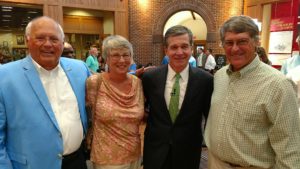
Photo courtesy of NC Department of Environmental Quality

Filed Under: Blog

Governor Cooper Opposes Offshore Oil Drilling

July 21, 2017 By chris

Governor Roy Cooper has announced his strong opposition to offshore drilling and seismic blasting along North Carolina’s coast. “Our coast is part of our identity,” he said, speaking to the press […]

Governor Cooper Opposes Offshore Oil Drilling

July 21, 2017 by chris

Governor Roy Cooper has announced his strong opposition to offshore drilling and seismic blasting along North Carolina’s coast. “Our coast is part of our identity,” he said, speaking to the press at Fort Macon State Park near Atlantic Beach.

Randy Sturgill-Oceana, Penny Hooper-NCIPL, Gov.Cooper, Michael Murdoch-Croatan Sierra Club

Penny Hooper, NCIPL Leadership Council Chair, was in the room for the Governor’s press conference. She was among representatives of faith communities, businesses, fishing families, beachgoers, and conservationists that have all joined together to protect our coast from drilling operations even as some political leaders push to let oil companies drill along the Atlantic coast. This is a big step in the effort to protect our coast, and it shows that Governor Cooper has been listening to our coastal communities and to you.

It means a lot when we show appreciation to our elected leaders for doing the right thing. Please take one minute to thank Governor Cooper by calling him at 919-814-2050.

You can let the Governor know you support the unanimously approved NC Council of Churches Governing Board Policy Statement opposing offshore drilling and seismic airgun blasting. Please also let him know that NC Interfaith Power & Light will continue our education and outreach campaigns for congregations across the state to promote clean, renewable energy, and hope-filled climate action responses.

This announcement is not just good news for our coast but for the entire state of North Carolina. The Governor’s decision defends our beaches and unique coastal economy. While this is cause for celebration, we can’t forget that President Trump’s administration will likely come out strongly against this decision. That’s why I’m glad we’re in this together.

I hope you’ll join us in thanking Governor Cooper.

Love God, Live Green, Liberate All!


Filed Under: Blog

Big Biomass is a Moral Injustice – Stop Enviva

July 19, 2017 By chris

Over 10,000 individuals and 50 organizations, representing millions of people, supporting communities, public health, climate and forests asked Governor Cooper to revoke the world’s largest wood pellet manufacturer’s flawed air […]

Big Biomass is a Moral Injustice – Stop Enviva

July 19, 2017 by chris

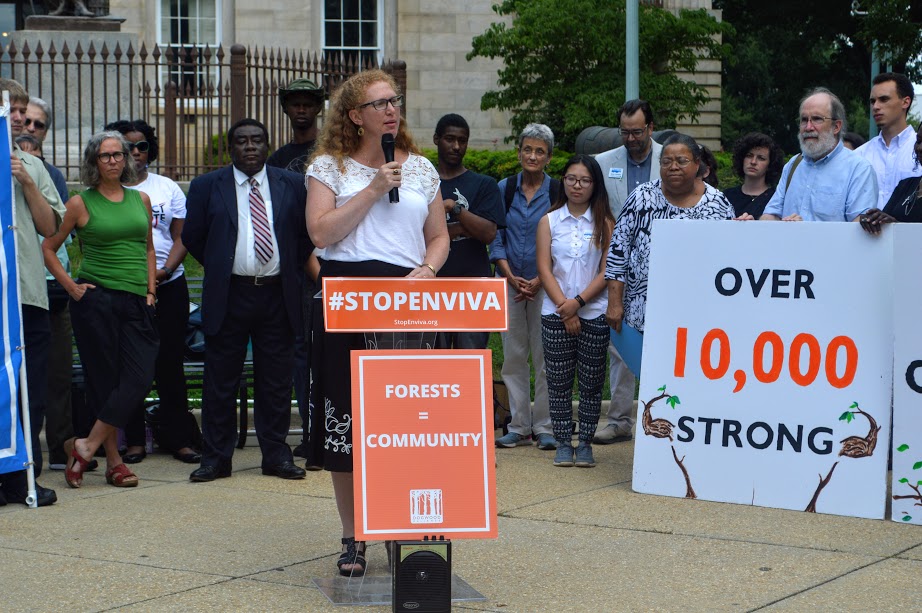
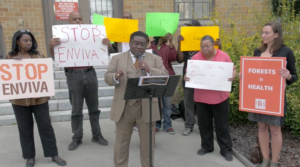
Over 10,000 individuals and 50 organizations, representing millions of people, supporting communities, public health, climate and forests asked Governor Cooper to revoke the world’s largest wood pellet manufacturer’s flawed air quality permit in Richmond County on Tuesday. The Raleigh press conference included 5 speakers from prominent NC organizations such as Dogwood Alliance, Concerned Citizens of Richmond County, and Clean Air Carolina. Susannah Tuttle of NC Interfaith Power& Light was among the speakers. Her press statement was as follows:
My name is Susannah Tuttle and I serve as the Director of NC Interfaith Power & Light, a program of the NC Council of Churches, representing 18 denominations and nearly one and a half million North Carolinians. We are called to be stewards, but are giving away our resources. Our faith calls upon us to stand with the people of Richmond County in their fight for clean air and healthy community. I hope that Governor Cooper can hear our call to stand with North Carolina communities, and put people above climate polluting industries like Enviva. Faithful Christians believe that God will redeem both people and nature in the new heaven and earth. Knowing that God intends one day to redeem nature should motivate Christians to view and act differently towards the environment. Christians should also be involved as much as possible in the process of redeeming nature here and now on earth as an expression of our own redemption and salvation and the “living out” of our faith. (Phil. 2:12-13; Jas. 2:14-25) In the case of a Christian forester or ecologist, for example, being involved in the restoration of a healthy forest ecosystem is consistent with and honors God’s ultimate plan for redeeming nature. In contrast, being responsible for widespread and complete destruction of a particular forest ecosystem does not seem consistent with nor does it honor God’s plan for redeeming nature.“Let the heavens rejoice, let the earth be glad, let the sea resound and all that is in it. Let the fields be jubilant, and everything in them. Let all the trees of the forest sing for joy. Let all creation rejoice before the Lord, for he comes, he comes to judge the earth. He will judge the world in righteousness and the peoples in his faithfulness.” (Psalm 96: 11-13)

The organizations contend that biomass and the wood pellet industry are an environmental injustice. Nowhere is this more clearly seen than Richmond County in rural North Carolina. For the last several years county officials have been working, mostly behind closed doors, with Enviva to gain approval for the construction of a wood pellet manufacturing facility in the town of Hamlet. Residents of the county have repeatedly attempted to deliver public comments to their elected officials at the Richmond County Commission, and have been denied on multiple occasions in a practice that NC Policy Watch reports “clearly violates the first amendment.”

“North Carolina forests do their job to clean the air when they are a living part of our environment”, said Terry Landsdell, Program Director at Clean Air Carolina. “From production to combustion, wood pellet chain emissions are higher than coal, release large quantities of respiratory pollutants and release levels of particulate matter that disproportionately affect residents already overburdened with health impacts like asthma and COPD from air pollution exposure.

Filed Under: Blog, Uncategorized

Church of the Nativity, Raleigh Awarded $10,000 Grant

July 19, 2017 By chris

The Episcopal Church recently announced the awarding of 16 grants totaling $123,910 in the second round of grantmaking managed by the Advisory Council for the Stewardship of Creation and approved […]

Church of the Nativity, Raleigh Awarded $10,000 Grant

July 19, 2017 by chris

The Episcopal Church recently announced the awarding of 16 grants totaling $123,910 in the second round of grantmaking managed by the Advisory Council for the Stewardship of Creation and approved by the Executive Council.

Among the recipients is Nativity, Raleigh, awarded $10,000 toward its work, Becoming the Good Soil, of reducing the serious effects of climate change by engaging in regenerative agriculture through carbon farming, specifically by supplementing land with compost. In simple terms, one goal of carbon farming is to increase soil organic matter (SOM) to help draw carbon out of the atmosphere and sequester it in the ground.

In addition to the implementation of carbon farming to local soil, Nativity will work to help educate individuals and congregations learn more about regenerative agriculture through, among other channels, the development of a white paper to be made available to all churches.

From Nativity:

“Caring for Creation has deep roots in our spiritual lives at Church of the Nativity, and for many years we have supported and been a local voice for North Carolina Interfaith Power & Light (NCIPL) in seeking hopeful solutions for climate change. To avoid severe climate change, reducing emissions from burning fossil fuels will not be enough. Carbon must also be withdrawn from the atmosphere and sequestered into the soil.”

Nativity’s four main goals are 1) educating and encouraging individuals and churches in the Episcopal Diocese of NC to make compost from organic waste, 2) building a statewide organization of the primary stakeholders within government, the private sector, and the farming and academic communities with the goal of launching large scale carbon farming in NC, 3) planning and hosting a NC Carbon Farming Summit meeting that will produce a comprehensive strategy for the project, and 4) publishing a white paper that will summarize the rationale and strategy for the project. 

Join us in congratulating Church of the Nativity and all the hard working individuals seeing this through!

For more information visit http://nativityonline.org/

Filed Under: Blog, Uncategorized

More wind energy, not less please!

June 30, 2017 By chris

It is becoming a national trend for politicians to “divide and conquer” by attacking the wind industry while supporting other forms of clean energy. This is fracturing the renewable energy community as folks […]

More wind energy, not less please!

June 30, 2017 by chris

It is becoming a national trend for politicians to “divide and conquer” by attacking the wind industry while supporting other forms of clean energy. This is fracturing the renewable energy community as folks are being forced to take positions that do not support one another. As Director of NCIPL I pray that we do not take sides and instead continue to support all sources of renewable energy without pitting one against another.

NCIPL is a member of the NC Sustainable Energy Association (NCSEA). Below is their statement on HB 589 and a summary of the legislation.

NCSEA’s Statement on the Passage of House Bill 589

NCSEA supported the original version of House Bill 589, which passed the House on June 7, and was the result of an extensive, 9-month-long stakeholder process and negotiations. This legislation would have been a bipartisan compromise that was overall good for consumers, industry and utilities. Unfortunately, the final negotiations that occurred late last night between the House and Senate on HB 589 became tarnished with the inclusion of an unnecessary 18-month moratorium on the permitting of wind projects through December 31, 2018, which was ultimately sold to legislators without any urging from the military. We are very disappointed in this outcome and are determined to take immediate steps to lessen this blow to our growing and diverse clean energy economy – and, by extension, all North Carolina consumers and business investors who would have otherwise certainly benefited from additional wind energy development. NCSEA is working now to ensure all participants in the stakeholder process leading up to this disappointing vote take any and all available action to remedy this reckless adoption of an otherwise strong policy.

Final Bill Summary: House Bill 589 
Below is a summary of the final version of HB 589, passed this morning after midnight, including the wind provision.

  1. Restarts Duke Energy’s Green Source Rider program, allowing large customers to work directly with renewable energy developers to purchase the type of renewable energy that makes the most sense for their businesses, customers, and employees;
  2. Legalizes the leasing of renewable energy systems and allows Duke Energy to participate in the leasing market;
  3. Creates a new rooftop solar rebate program that will offer Duke Energy’s residential and commercial customers rebates for 20 MW of solar per year for five years, for a total of 100 MW – at least tripling the amount of rooftop solar in North Carolina over the next five years.
  4. Requires Duke Energy to create a modestly-sized 40 MW community solar program;
  5. Directs a study to understand the values and benefits that energy storage can provide to North Carolina’s grid; and as of last night,
  6. Imposes an 18-month moratorium on permitting issuance for all wind energy projects, effective January 1, 2017*.

*While still unacceptable, it should be noted that the 18-month wind permitting moratorium is less severe than the 4-year moratorium proposed in the Senate earlier, which sought to ban “consideration of applications for a permit”and “the issuance of permits” for wind energy facilities and wind energy facility expansions. The final, 18-month version still allows preliminary consideration of wind projects, all the way up to the permitting issuance.

Click here to see how your representative voted on this energy legislation.

The Governor has three options right now: to sign the bill, to veto the bill, or to let it become law without his name attached. I have confidence that the Governor and his team of experts will do their best to make the most appropriate decision for the current state of politics in NC.

Prayers for the future of clean energy in our state,

~S*

—
*Susannah Tuttle, M.Div
Director, NC Interfaith Power & Light

Filed Under: Uncategorized

Rising Up With Richmond County

June 23, 2017 By chris

“Biomass” may sound like a clean idea, but it actually means cutting down and turning trees into fuel pellets to be burned for energy — creating more carbon pollution than […]

Rising Up With Richmond County

June 23, 2017 by chris

“Biomass” may sound like a clean idea, but it actually means cutting down and turning trees into fuel pellets to be burned for energy — creating more carbon pollution than coal, accelerating global warming and driving climate chaos.

North Carolina’s former governor opened the floodgates to the wood pellet export industry, which is tearing down our special forests to make wood pellets for export where they are burned in power stations to generate electricity.

Rescind the Enviva Richmond County Wood Pellet Mill Air Permit Now

Enviva, the world’s largest wood pellet exporter, already operates three mills in North Carolina. These mills have been the subject of mounting scientific and community evidence documenting that wood pellets are bad for the climate and a dirty and destructive fuel. As with other dirty fuel industries, the wood pellet industry disproportionately impacts our most vulnerable, including low-income and communities of color.

Now Enviva is proposing to build their fourth wood pellet biomass facility in the town of Hamlet in rural Richmond County. 50 acres of forests a day in North and South Carolina would be turned into pellets and then shipped to Europe to burn for electricity. This community is already dealing with pollution and environmental injustice due to other polluting industries and has been ranked 90 out of 100 counties in the State of North Carolina for health outcomes.
The air permit issued to Enviva under the last administration by the NC Department of Environmental Quality contained false information regarding the plant’s location and violated air quality regulations, yet no public hearing was ever held and the citizens in the affected community were not given proper notice or opportunity to comment.

Rise up with Richmond County and say “NO!” to Enviva and the biomass wood pellet industry.

Neither the local citizens, nor the state of North Carolina needs another wood pellet mill. The health and economic impacts would be devastating, and the community doesn’t want it. A victory in Richmond County is a victory for the South, for the forests, and for all the communities in the South who face environmental injustice.

In addition to NC Interfaith Power & Light’s support for clean energy we recognize we must put the protection of our forests and the health, safety and prosperity of our most vulnerable communities at the forefront of North Carolina’s climate agenda.

Click here to sign a letter to Governor Roy Cooper and DEQ Secretary Michael Regan to show we faithfully stand with the citizens of Richmond County to stop this facility from being built.

Filed Under: Uncategorized

  • « Go to Previous Page
  • Page 1
  • Interim pages omitted …
  • Page 10
  • Page 11
  • Page 12
  • Page 13
  • Page 14
  • Interim pages omitted …
  • Page 37
  • Go to Next Page »

Footer

Contact

Eco-Justice Connection
27 Horne St.
Raleigh, NC 27607
(919) 828-6501
info@ncchurches.org

Subscribe

Click here to subscribe to newsletters and blog updates.

  • Facebook
  • Instagram
  • Twitter

Copyright © 2022 Eco-Justice Connection · All Rights Reserved · Website by Tomatillo Design