• Skip to primary navigation
  • Skip to main content
  • Skip to footer
Eco-Justice Connection

Eco-Justice Connection

An initiative of the North Carolina Council of Churches

Get Involved Donate
  • About
    • Mission / Goals
    • Partnerships & Collaboratives
    • History / Timeline
  • Voices
  • Initiatives
    • Faithful Advocacy
    • Climate & Energy
    • Environmental Justice
    • Local to Global
    • Climate & Health
    • Resiliency and Restoration
  • Resources
  • NCCC

Search Eco-Justice Connection

EJC Voices

NCIPL Testifies at EPA Hearing on Clean Power Plan
December 7, 2017 By chris

Last week North Carolina Interfaith Power & Light spoke at the EPA public hearing in Charleston, West Virginia, on the proposed repeal of the Clean Power Plan.  EPA has proposed that […]

NCIPL Testifies at EPA Hearing on Clean Power Plan

December 7, 2017 by chris

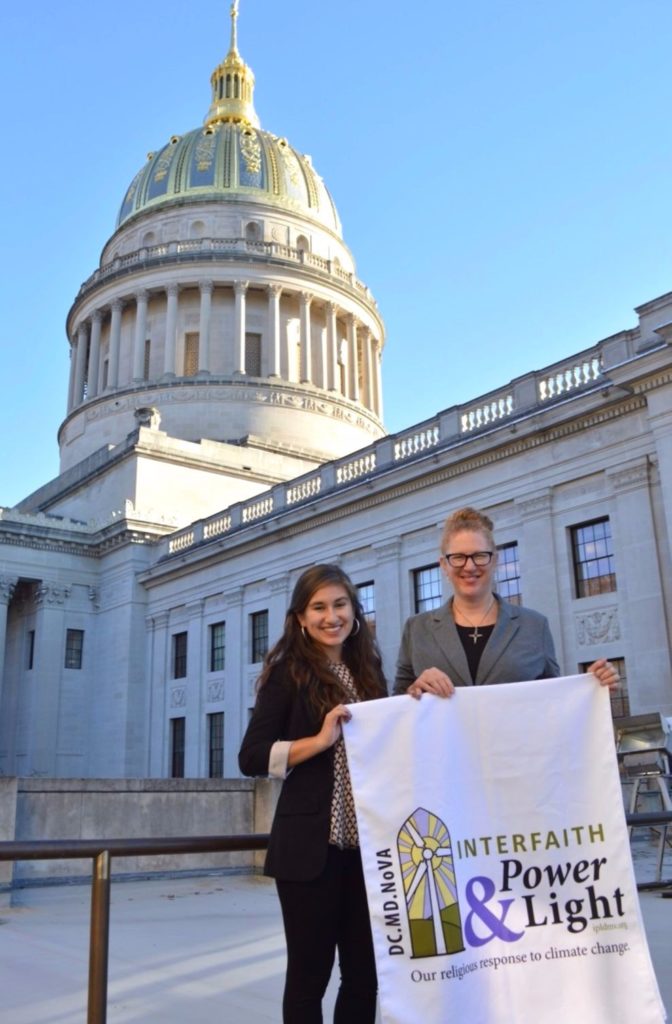
Last week North Carolina Interfaith Power & Light spoke at the EPA public hearing in Charleston, West Virginia, on the proposed repeal of the Clean Power Plan.  EPA has proposed that the Clean Power Plan is not consistent with the Clean Air Act.

The EPA held the public hearing on this critical issue in the heart of coal country. Faith leaders, including those from West Virginia Interfaith Power & Light, spoke in support of the Clean Power Plan because it sets flexible and achievable limits on otherwise unlimited dumping of carbon pollution from power plants into our air and it encourages the development of clean, renewable energy.

Susannah Tuttle, Director of NCIPL, was at the hearing last week. She testified, in part:

It should be expected that our elected officials and the EPA act on our moral obligation to address unlimited carbon pollution coming from the nation’s power plants, the single largest source of global warming pollution in the country. The standards laid out by the Clean Power Plan will help usher in clean energy solutions like improved efficiency and solar power: things that North Carolina Interfaith Power & Light congregations have been using in their facilities for years to reduce emissions and save money. Emerging wind and solar companies have been in a David and Goliath struggle against the well-funded coal and gas industries.  The Clean Power Plan helps create a dynamic move toward cleaner energy.

Michelle Peedin, Program Associate for NCIPL, was also at the hearing. She testified:

This friday I will be 24 years old. So when we take a look at these projections for 30 or 50 years out, God willing, I will be here.  I will be alive after many of the current members of legislature will have passed. I will be alive after many of the current policies will have been put in place for decades. My generation and our families will be living and breathing the repercussions of today’s decisions. That is why I made the decision a year ago to work towards addressing the ecological and justice issues of climate change as a faith-based initiative through NCIPL. Because, like a quote I embodied many years ago, “if not now, when? If not me, who?”

Others spoke up as well. 72-year-old Stanley Sturgill, who mined coal for decades in Kentucky and now has black lung disease said:

“Our health, environment and global climate are actively being destroyed. And it is clear to me that EPA Administrator Scott Pruitt and President Trump are accelerating and cheering on the damage. I have come here today to ask you to stop. For the sake of my grandchildren and yours, I call on you to strengthen, not repeal, the Clean Power Plan. We are still literally dying for you to help us.”

There is a comment period now and people of faith need to speak up and be counted:

Please speak up! Click here to send a message to the EPA that you oppose any repeal or weakening of the Clean Power Plan.

The EPA announced today that they will hold three additional public hearings on a proposal to withdraw the Clean Power Plan, in San Francisco; Gillette, Wyoming; and Kansas City, Missouri.

EPA Administrator Scott Pruitt in a press release said the change was “due to the overwhelming response” to two days of hearings in West Virginia last week.

People of faith have a moral obligation to care for and protect our children and future generations by addressing the effects of climate change and carbon pollution, especially as they wreak havoc on the poorest and most vulnerable among us. Let’s make the right and moral choice to implement sensible climate solutions that speed the transition to a just and equitable clean energy economy.


Filed Under: Blog, Uncategorized

Help us meet our matching grant!

November 28, 2017 By chris

As people of faith we have an increasingly important role to play in bringing together diverse voices to speak on behalf of those whose voices are not heard - the most vulnerable in our society, including children and future generations. Join us by making a tax-deductible donation to NCIPL - every gift made will be matched up to $13,500. Please give today!

Help us meet our matching grant!

November 28, 2017 by chris


CLICK HERE to make a secure, tax-deductible donation to NCIPL. Every Gift will be matched through Interfaith Power & Light’s state affiliate grants program up to $15,000.

We prepare for the future with anticipation knowing that our leadership in developing hope-filled, positive responses to climate change supports the health of our ecosystems and nurtures reverence toward our sacred and interconnected Earth community.

Prayers for Peace & Healing,


NCIPL is a fiscally autonomous program and operates entirely by restricted funds. NC Council of Churches 501c3 Federal ID number is used on IRS tax donation receipts. PLEASE DONATE TODAY!

Filed Under: Blog, Uncategorized

Reject the Tax Plan: Don’t Sacrifice Creation for Big Business

November 28, 2017 By chris

In order to deliver huge tax breaks to corporations and wealthy individuals, this package would slash tax credits for renewable energy, pull the plug on electric cars, and open the pristine Alaska National Wildlife Refuge to oil drilling.

Reject the Tax Plan: Don’t Sacrifice Creation for Big Business

November 28, 2017 by chris

On Thursday, the House passed an irresponsible, unethical, and environmentally devastating tax bill. Now we must stop it in the Senate.

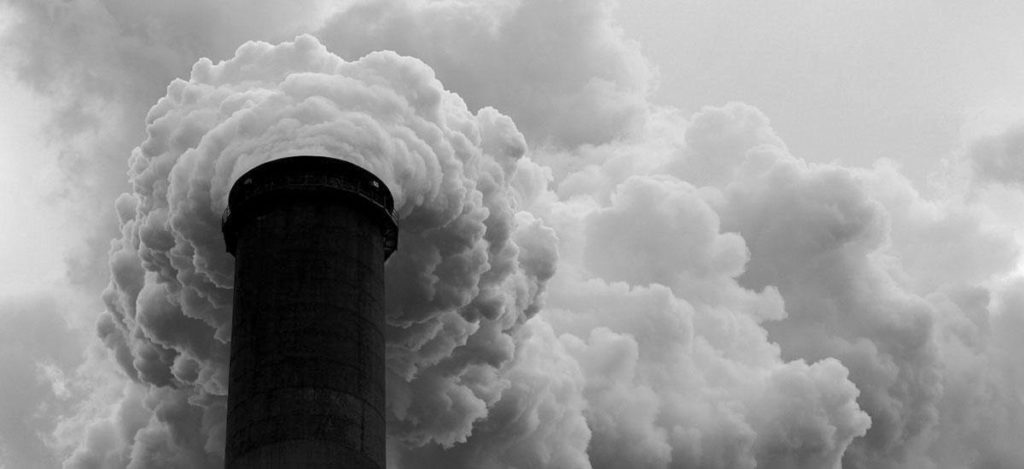
In order to deliver huge tax breaks to corporations and wealthy individuals, this package would slash tax credits for renewable energy, pull the plug on electric cars, and open the pristine Alaska National Wildlife Refuge to oil drilling. All while maintaining $15 billion in subsidies for the fossil fuel industry. 

Speak out against this immoral tax plan.

This tax plan is moving fast – and that’s by design. Polling shows that a majority of voters oppose these unfair tax breaks, including a majority of Republicans. So their only chance of getting it through is to pass it quickly with minimal hearings and little attention. The 400-page House bill passed in record time, with NO hearings and over the objections of Democrats and some Republicans.

Please, urge your senator to oppose this devastating tax bill.

Cutting tax credits for renewable energy could slow or even reverse the extraordinary momentum we have been seeing in the adoption of renewable energy in the past few years. You, and thousands of other people of faith called congressional offices, mailed postcards, sent emails and visited elected officials to make those credits law – we can’t lose them now, just when they are starting to get results.

We can’t let this bill pass. God’s Creation and our children’s future are too important.

Click here to send a message to your senators that you oppose this tax plan that does not reflect our country’s morals or values.

We need to make sure our senators know that people of faith DO NOT support a tax bill that ignores the threat of global warming, threatens our sacred Alaska wilderness, and costs lives.

Filed Under: Blog, Uncategorized

The environmental crisis is not environmental. It is spiritual.

October 25, 2017 By chris

Behind all environmental problems that society faces, whatever time period one analyzes, wherever one can go and whatever one can do, there is going to be greed, envy, ambition, selfishness, […]

The environmental crisis is not environmental. It is spiritual.

October 25, 2017 by chris

Behind all environmental problems that society faces, whatever time period one analyzes, wherever one can go and whatever one can do, there is going to be greed, envy, ambition, selfishness, apathy and those are moral and spiritual issues. Nonetheless, it is usually scientists who are expected to find a solution, but men flaws are not amongst the expertise of the environmental science field. Gus Speth, who helped found the Natural Resources Defense Council and was dean of the Yale School of Forestry and Environmental Studies, told a British radio presenter in 2013:

“I used to think that top global environmental problems were biodiversity loss, ecosystem collapse, and climate change. I thought that with 30 years of good science we could address these problems, but I was wrong. The top environmental problems are selfishness, greed, and apathy, and to deal with these we need a spiritual and cultural transformation. And we scientists don’t know how to do that.”

Science and religion do not like to hold hands, but finding and establishing a positive nexus between faith and environmentalism will result in a powerful conjunction of forces against Climate Change, our most complex challenge ever faced.

Pope Francis says, in his Encyclical Laudato Si: On Care for our Common Home that although science and religion possess “distinctive approaches to understanding reality, [they] can enter into an intense dialogue fruitful for both”. He continues, stating that the solutions to such complex ecological crisis and its multiple causes will not come from only one interpretation of reality. Similarly, E. O. Wilson in his book “The Creation: An Appeal to Save Life on Earth”, states: “Religion and science are the two most powerful forces in the world today”.

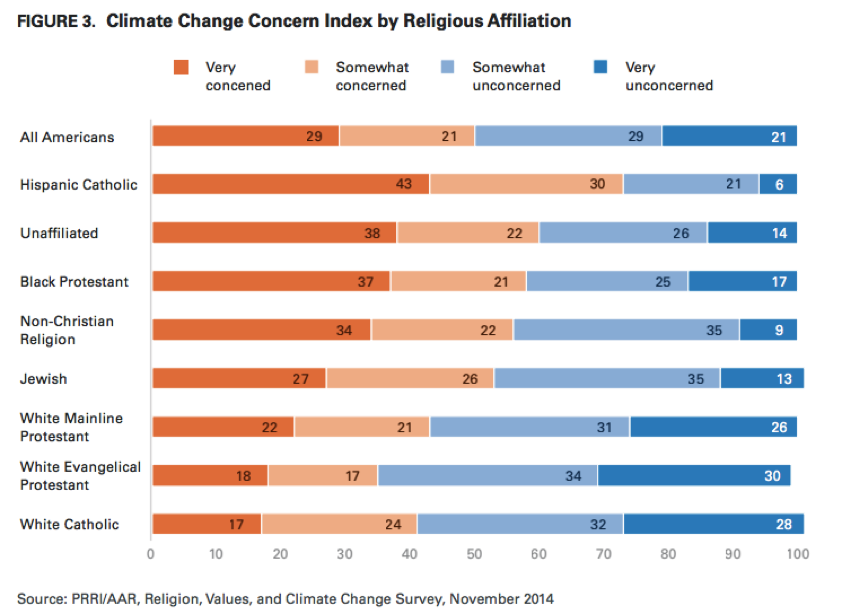
But despite both the religious leader and the secular humanist aforementioned sharing essentially the same ideas, many Christians do not believe Climate Change is endangering our society. The Public Religion Research Institute (PPRI) and the American Academy of Religion (AAR) created and applied the Climate Change Concern Index in a survey, in 2014. This index is based on two questions: whether respondents perceived climate change to be a crisis and whether respondents believed climate change would negatively affect them personally (you can know more about AAR and read their whole report here). The graphic below shows the alarming discrimination of the Climate Change Index by religious affiliation.

The International Union for the Conservation of Nature and Natural Resources (IUCN) meets every four years. Last year (2016) the World Conservation Congress was held in Honolulu, Hawaii. The congress already showed the importance of such necessary shift by including a ‘Spirituality Journey’ in the program, for the first time. At the opening ceremony, ‘Our heavenly Father’ was thanked for his ‘Creation.’ Peter Harris, who established and runs A Rocha, a Christian conservation organization, was in the congress and wrote about why conservation is a gospel issue. He analyzed that though many conservation professionals and scientists have a living Christian faith, integrating it into their working lives can be a real challenge. “They work with paradigms and language, such as ‘natural resource management’ or ‘ecosystem services,’ that took shape before the days of Christian involvement.”

A Rocha is a Christian organization that engages communities in nature conservation and works in cooperation with other organizations and individuals who share their commitment to a sustainable world. The organization is cross-cultural, drawing on the insights and skills of people from the 22 countries where it works. It was the only Christian organization present in the IUCN congress. Trying to bring Christians into the conservation conversation, however, will also expose their lack of involvement in environmental issues, which Peter Harris named as “uncomfortable truths.”

Among Christians, there has to be more education related to Climate Change. The Report on Faith and Ecology made by the Interfaith Center for Sustainable Development in 2015 revealed that just over one-third of Americans say their clergy leaders speak about climate change often (11%) or sometimes (25%). More than 6-in-10 Americans say their clergy leaders rarely (29%) or never (33%) reference climate change. Therefore the most effective way to create awareness among Jesus followers is to have its leaders bring the subject to the pulpits. The low incidence of American clergy teaching on climate change is reflected in how American citizens view the issue of climate change: not as a moral or religious issue, according to a recent Yale-George Mason poll. E.O. Wilson, again, throws an interesting insight on these matters. He says “if religion and science could be united on the common ground of biological conservation, the [environmental] problem would soon be solved.”

Since there is a need for Christians to get involved in environmental issues and interrelating them with their faith, here are some practical actions anyone could start doing right now.

1. Do your part.

If you have ever heard the sentence “Think global, act local”, it says it all. Practice recycling at home and, even if there is no collection in your house or apartment, you can usually find a drop-off recyclable site nearby. Also value local products, by buying at the farmer’s market or considering locally made items as Christmas gifts, for example.

2. Share what you know.

Caring about creation is stated in the Bible, in Genesis 2.15. Bringing the topic up for discussions or talking about it with the leadership of your religious organization could have a positive impact in your faith community.

3. Get involved.

Participating in organizations such as A Rocha, getting involved in a Community Garden or any organization that serves your community is a great way to care for the people around you, therefore caring about the environment as well.

4. Be the difference.

Nothing will send a message more effectively than our actions. Wherever you work, study or practice your faith, have attitudes that show your care for the creation. That would take us back to number one!

In summary, Christian restoration and redemption beliefs have the potential to advance conversations about sustainability, by highlighting concrete practices that might enable a societal transition regarding ecological health and sustainability. On the other hand, Science knowledge can move Christian ethics beyond the tendency to focus only on a one-sided thinking about nature, towards a reflection on what constitutes right or good actions, in relation to Earth.

Filed Under: Blog

Don’t let Trump Repeal and Replace our Clean Power Plan

October 10, 2017 By chris

After failing to “repeal and replace” the Affordable Care Act, the Trump administration now has its sights set on our Clean Power Plan. And for this one, they won’t have […]

Don’t let Trump Repeal and Replace our Clean Power Plan

October 10, 2017 by chris

After failing to “repeal and replace” the Affordable Care Act, the Trump administration now has its sights set on our Clean Power Plan. And for this one, they won’t have to go through Congress.

EPA Administrator Scott Pruitt has announced his intention to “withdraw the so-called Clean Power Plan” — and replace it with a far weaker standard.

The Clean Power Plan is one of the most powerful tools we have to curb carbon pollution from the power sector and move our country toward a clean energy economy. Weakening this plan would allow dirty, coal-burning, inefficient power plants continue to pollute our air and water longer.  And it is the most vulnerable among us — children, the elderly, people with asthma — who will suffer the most.

When queried as to what a replacement plan might look like, Pruitt has suggested we “take a look at the Oklahoma plan,” which he wrote with industry in 2014. This Dirty Power Plan would keep antiquated and dangerous coal plants operating for years longer, expose millions of Americans to health-threatening pollutants and continue to heat up our climate.

Greenhouse gas emissions from power plants contribute to climate change and warmer air and water temperatures that cause extreme weather events like Hurricanes Irma, Harvey and Maria to be deadlier and more destructive. Repealing the Clean Power Plan is a double-whammy for our communities: it will result in increased rates of respiratory illness and premature death while worsening climate change. As people of faith and conscience, we must stand up, speak out, and demand that our air and water not be needlessly polluted for the profits of a few.

Congregations and faith communities are taking action to protect Creation in our own facilities, reducing emissions, saving energy and saving money.  If we can do it, large corporations and power plants can do it too.

Click here to sign Interfaith Power & Light’s letter telling the Trump Administration not to repeal the Clean Power Plan.

A majority of Americans want their government to act on climate change.  If we stand together and demand it, this “repeal and replace” attempt will meet the same fate as the one on health care. But we must act now —  our children’s future depends on it.

Filed Under: Blog

Praying in Opposition to Fracked Gas Pipelines

September 18, 2017 By chris

The Atlantic Coast Pipeline met more opposition last week. This time in the form of a prayer gathering by faith leaders outside the Department of Environmental Quality office. DEQ and […]

Praying in Opposition to Fracked Gas Pipelines

September 18, 2017 by chris

The Atlantic Coast Pipeline met more opposition last week. This time in the form of a prayer gathering by faith leaders outside the Department of Environmental Quality office. DEQ and the Cooper administration are currently considering a 401 water quality permit application that the pipeline must have before moving ahead with construction later this fall.

Susannah Tuttle, Director of NC Interfaith Power & Light, brought word to the assembly of a resolution adopted by the NC Council of Churches Governing Board condemning the construction of pipelines such as the Atlantic Coast Pipeline. The Council of Churches, a statewide ecumenical organization spanning eighteen different denominations, counts more than 1.5 million North Carolinians as members of its participating bodies.

Tuttle read from the resolution entitled “Statement Opposing Fracked Gas Pipelines”. The statement read in part, “We resolve that any new investment in energy infrastructure based on the extraction of fossil fuels is morally reprehensible and, as people of faith, we believe it is an abuse of the God-given gift of creation for which we are charged to care.”

Greg Yost, a pipeline opponent from Madison County, also spoke. Yost was on day nine of a two week, water-only fast, sitting each day in front of the DEQ entrance. Yost explained that his presence there is meant to signal that the Cooper administration’s pipeline decision is at root a spiritual issue. “During this period of waiting,” Yost said, “we are physically passive, but spiritually active. We are helping the Governor and [DEQ] Secretary Regan understand that bold leadership on their part will be met with support by North Carolinians across the state, no matter what [pipeline developer] Duke Energy may want.”

The Reverend Mac Legerton, a United Church of Christ minister from Robeson County, facilitated the service. Legerton, who still works daily to help his community recover from the devastation of Hurricane Matthew, opened a time of prayer for victims of Hurricanes Harvey and Irma. Legerton brought with him a native flowering plant that he says will now be passed from county to county in eastern North Carolina to be watered by rivers, creeks, and wetlands that the proposed pipeline would cross. The flower will then be returned to DEQ and offered as a living sign of the importance of its duty to see that North Carolina’s water resources are protected.

On Friday, September 15th DEQ announced a decision will be delayed – likely until mid-December – on whether to permit the controversial project.

Without fanfare or press release late yesterday, the state issued a four-page “request for additional information,” part of its duty under the federal Clean Water Act to ensure the natural gas pipeline won’t harm the over 320 rivers and streams and hundreds of acres of wetlands in its path.

We must continue our prayers that this pipeline will be permanently rejected by the strong leaders of North Carolina. Blessed Be!

Filed Under: Blog Tagged With: environment, pipeline

  • « Go to Previous Page
  • Page 1
  • Interim pages omitted …
  • Page 9
  • Page 10
  • Page 11
  • Page 12
  • Page 13
  • Interim pages omitted …
  • Page 37
  • Go to Next Page »

Footer

Contact

Eco-Justice Connection
27 Horne St.
Raleigh, NC 27607
(919) 828-6501
info@ncchurches.org

Subscribe

Click here to subscribe to newsletters and blog updates.

  • Facebook
  • Instagram
  • Twitter

Copyright © 2022 Eco-Justice Connection · All Rights Reserved · Website by Tomatillo Design