
• Skip to primary navigation
  • Skip to main content
  • Skip to footer
Eco-Justice Connection

Eco-Justice Connection

An initiative of the North Carolina Council of Churches

Get Involved Donate
  • About
    • Mission / Goals
    • Partnerships & Collaboratives
    • History / Timeline
  • Voices
  • Initiatives
    • Faithful Advocacy
    • Climate & Energy
    • Environmental Justice
    • Local to Global
    • Climate & Health
    • Resiliency and Restoration
  • Resources
  • NCCC

Search Eco-Justice Connection

EJC Voices

Unitarian Universalist Fellowship of Hendersonville

December 1, 2015 By chris

UUFH Celebrates Its Commitment to Renewable Energy The Unitarian Universalist Fellowship of Hendersonville (UUFH) is celebrating the installation of a 40-panel solar array on its sanctuary roof. This installation is […]

Unitarian Universalist Fellowship of Hendersonville

December 1, 2015 by chris

UUFHsolarpanels

UUFH Celebrates Its Commitment to Renewable Energy

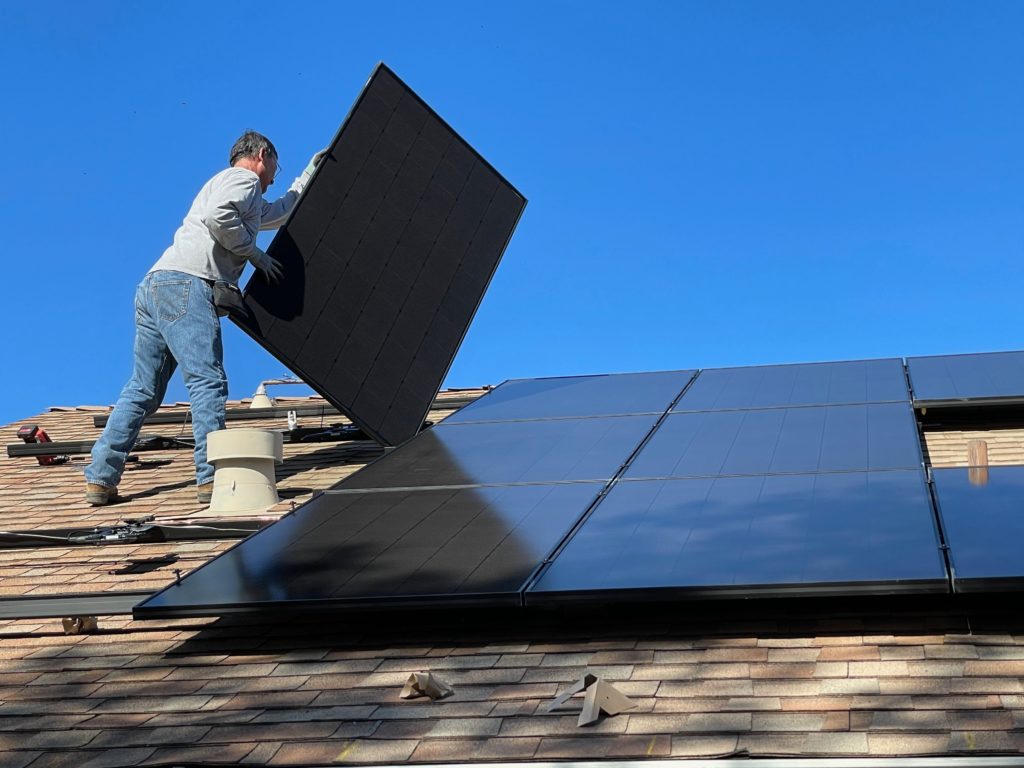
The Unitarian Universalist Fellowship of Hendersonville (UUFH) is celebrating the installation of a 40-panel solar array on its sanctuary roof. This installation is evidence of the congregation’s commitment to renewable energy and is the culmination of a two year program to become more environmentally friendly according to the Green Team coordinator Jan Partin.
.
After a year of planning, the UUFH Green Team took bids to install a system that would produce 80-90% of the 20000 KWhr electrical usage in its main building. The congregation anticipates an annual energy savings of $2400-$3000. M.B. Haynes Energy Solutions was selected in August and construction began in October.

The congregation has been working toward certification as a “green sanctuary,” an environmental and conservation program sponsored by the Unitarian Universalist Association. The overall greening of the church encourages the congregation and individual members to adopt sustainable practices. The solar panel project, titled Let the Sunshine In, was an opportunity to fulfill the congregation’s desire to demonstrate green principles and to take advantage of North Carolina’s renewable state tax credit. The congregation raised $40,000 in two months to fund the project. Solar panel project team members were Jan Partin, Steve Tipps, Joe Criscione, RE Director Vicki Benavides, and Reverend Jim McKinley.
.
This effort aligns with the core values of Unitarian Universalists and brings our faith into action. By adopting solar energy for our building, we set an example for our congregation, our community, and other Henderson County area faith communities considering how they could also reduce their carbon footprint with sustainable energy sources such as solar.

The Unitarian Universalist Fellowship of Hendersonville, located on the corner of Kanuga and Price Roads, offers Sunday services at 10:30am; Religious Education classes at 10:15am; and childcare at 10:15am. For more information, contact the UUFH office at 828-693-3157 or office@uufhnc.org, or visit us online at www.uufhnc.org.

Filed Under: Solar, Success Stories

United Church of Chapel Hill Solar Project

November 18, 2015 By chris

Our Solar Journey at United Church of Chapel Hill On November 6, 2015, the latest photovoltaic array on a North Carolina house of worship went online. The 84.76 kW, 326 […]

United Church of Chapel Hill Solar Project

November 18, 2015 by chris

ucch-solar-compelte-2-1024x576

Our Solar Journey at United Church of Chapel Hill

On November 6, 2015, the latest photovoltaic array on a North Carolina house of worship went online. The 84.76 kW, 326 panel system will generate 60% of our annual electricity needs at United Church of Chapel Hill (UCCH) and reduce our overall carbon footprint by a minimum of 44% next year and for years to come. The project was funded as part of a congregation-wide, multi-purpose capital campaign using a “donation model” with the option for individual donors to receive North Carolina state tax credits for the portion of the campaign devoted to the solar project.

Our solar journey began in 2011 when a subcommittee of United Earth Ministries (UEM) formed to explore significant energy saving and renewable energy options for the church. UEM is a committee of the Board of Justice, Outreach and Service, housed in this board because of the intersection of care of God’s creation, and both social and intergenerational justice. Prior to the solar project, UEM had laid ground work with the congregation by sponsoring education and devotional programs for adults and youth, and by working with the building and grounds volunteers and staff toward sustainability by going after the “low hanging fruit” of energy efficiency. By 2011, with the science of climate change strengthening, we began to think beyond energy efficiency, fact-finding and brainstorming about renewable energy sources and financing.

Initially, we investigated both solar and geothermal HVAC, and concluded that solar was our only realistic choice. We then looked into funding options for solar that would allow us to benefit from both state and federal tax credits using the standard calculus of “return on investment” and the concept of forming a small limited liability company (LLC) with a few investors as funders. The LLC idea was that the net cost to the church would be minimal and to the investors virtually nil. What we concluded after many months of research and discussion was that such an approach would likely result in an array that would generate less than 3% of our electricity needs and exclude most of the congregation from participating in the project.

Our breakthrough came when we realized that our thinking about funding was out of sync with our faith and mission as a congregation. The “return on investment” (ROI) calculus was the wrong metric. We remembered that care of God’s creation was/is part of our call to faith and mission. As a congregation our decisions on mission work have always been based on what is right to do. Once we discern what is right, we figure out how to fund the mission. UEM realized we needed to think of the solar project in the same way. This opened the way not only to dream of a much larger system but also to invite the whole congregation to participate in this mission.

As UEM was coming to this important realization, our church leadership was also realizing that it was time for a capital campaign to do some critical maintenance of our building. They decided to think big and develop a “vision 2020” for the whole church. All the boards were invited to propose high priority projects for the campaign to be launched in 2013. UEM was ready and proposed the large-scale project that would reduce our carbon footprint substantially and align with the global needs identified by the Intergovernmental Panel on Climate Change. We also wanted a project that would have a visible component to act as a “billboard for care of God’s creation” and hopefully as an inspiration for other churches, synagogues, mosques and temples in the state. The congregation embraced the project whole-heartedly. All those who participated in the capital campaign contributed a portion of their gifts to the solar project. Our roof was made solar ready in 2014 and the solar array was designed, approved by the congregation, and installed in 2015. This has been one of our most exciting and energizing mission projects in recent years.

We are fortunate to have members of our congregation who were able to provide technical expertise on this project. Among the talents on the energy committee were engineers who asked and received answers to all the important technical questions and managed the project, a lawyer who researched and explained the federal and state tax credit rules to the church leaders, and energetic volunteers who communicated the project to lay leaders and the general congregation. Once we decided on the donation model, we interviewed three solar installers, developed a rating instrument to help us choose among them, and settled on YES! Solar Solutions as our provider. YES! calls the UCCH installation their crown jewel, because it is large and especially because it includes a highly visible portion on a trellis that spans over 120 feet across the front of the church. This beautiful 76-panel array on the trellis truly is a billboard for care of God’s creation and a daily reminder to all who enter the building of the congregation’s commitment to sustainability and future generations.

UCCH-solar-front

Some facts about the UCCH project that might be of interest include:

  • 326 REC solar panels (260 watts each)
  • 4 SolarEdge inverters
  • 163 SolarEdge optimizers
  • 5,720 square feet of roof
  • We can monitor the function of each pair of panels individually through the SolarEdge website and quickly identify problems for rapid resolution
  • We are net-metering which means that we use our own solar power but have no storage batteries.
  • When we make extra energy it goes back to the grid and Duke Energy subtracts an equivalent amount of energy charges from our bill, saving us money.
  • The solar panels will degrade by no more than 0.7% per year and after 25 years they will still perform at 80% or more of their original capacity. They will likely continue to produce electricity for much longer.
  • The project cost approximately $240,000, all of which was raised by donation within the larger capital campaign. If we were measuring ROI, the project will pay for itself in energy savings over its useful life

Our system’s 84.76 kilowatts will generate 110,920 kilowatt hours of electricity each year, enough to power 10 homes each year and annually equivalent to

  • Removing 151,000 pounds of carbon from the atmosphere
  • Eliminating 149,000 vehicle-miles from the road
  • Preventing 90,000 pounds of coal from being burned
  • Planting 1760 trees to help sequester carbon
  • In combination with energy efficiency measures undertaken at UCCH regarding HVAC and lighting systems, we have reduced our carbon footprint by 53% per year.

The congregation of UCCH is thrilled to be harvesting clean, renewable energy from the sun. This is the story of our love for the world and our hope to be a good family member with our sister faith communities who are also working for the welfare of all. We are joining 14 other faith communities in collectively bringing 336 kW of faithful power to North Carolina. We are eager to share our story and our practical experience with interested faith communities. We hope that this work will “go viral” and many other congregations will commit to help our world transition to truly clean, renewable and sustainable energy, honoring God and preserving the world for future generations.

May it be so!


Visit United Church of Chapel Hill online at: http://unitedchurch.org

Filed Under: Blog, Solar, Success Stories

Pope Francis’ visit to the U.S.

September 29, 2015 By chris

For faith-based environmental activists, Pope Francis’s visit to the United States had a major effect even before he set foot on American soil. Now they hope his trip’s influence on […]

Pope Francis’ visit to the U.S.

September 29, 2015 by chris

For faith-based environmental activists, Pope Francis’s visit to the United States had a major effect even before he set foot on American soil. Now they hope his trip’s influence on their cause will reverberate long after he’s gone.

The Pope’s visit to America took place just months after issuing his encyclical on the environment, encourages Rev. Canon Sally Bingham, founder and president of Interfaith Power & Light. “To have Pope Francis come out and bring this message from such a powerful, moral foundation of the world has given us a tremendous boost.”

LoveIsOurMission

“This is really bringing communities together,” said Susannah Tuttle, director of NC Interfaith Power and Light, a program of the NC Council of Churches and state-affiliate to a national network leading the moral responsibility message to protect the environment. “It’s just so exciting. It’s like waking up and getting to talk about issues like a changing climate from a place of opportunity, hope and resilient response.”

The hope is that preachers in various faith traditions have openly received Pope Francis’ message and will begin speaking preaching about a moral duty to confront climate change. “Some faith leaders been afraid to get into the pulpit and talk about something that is seen as a political issue,” Rev. Bingham said. “But the pope has given them the opportunity and the responsibility to now speak about it from the pulpit. So I see it as a really big change-maker.”

On the governmental front, Rev. Bingham notes that Congress has 137 Catholics. She hopes many will hear the Holy Father and be moved to action. “Perhaps they need to look at this from a moral perspective rather than a political one, maybe they can step outside of the party line and do the right thing.”

NCIPL-sticker-1

Throughout the week of the Pope Francis’ U.S. visit, North Carolina faith communities united in support of clean energy and to heed the papal call to act on climate change. Vigils and activities organized through the network of NC Interfaith Power & Light were held in Raleigh, Greensboro, Morehead City, Asheville and Durham.

Organizers hope such events will build momentum for the United Nations Conference on Climate Change, which begins Nov. 30 in Paris. Delegations will discuss whether their nations can commit to reducing greenhouse gas emissions by certain amounts in years ahead.

Filed Under: Blog

Muslim American Society of Charlotte Announces First Major Solar Installation at a Mosque in NC

September 11, 2015 By chris

This week the Muslim American Society (MAS) of Charlotte is launching a program to install solar panels on the homes of 40 congregants and their mosque in east Charlotte. The […]

Muslim American Society of Charlotte Announces First Major Solar Installation at a Mosque in NC

September 11, 2015 by chris

charlotte-e1441998497416This week the Muslim American Society (MAS) of Charlotte is launching a program to install solar panels on the homes of 40 congregants and their mosque in east Charlotte. The program is unique both for the amount of solar that is slated for installation, as well as the financing model, and will make the mosque at MAS of Charlotte the first in North Carolina, and among the first in the country, to get solar panels. This initiative, led by congregants at MAS of Charlotte, comes just weeks after the Islamic Declaration on Climate Change from prominent Islamic scholars in support of binding, international climate change mitigation policy and renewable energy solutions.

“We are thrilled to answer the moral call to care for creation by using resources more wisely,” said Amir Rahman, project manager and member of MAS Charlotte. “At the same time, we are able to save our community members funds typically spent on electricity.”

Screen-Shot-2015-09-11-at-2.38.49-PM-e1441997360618

Once members of MAS CLT purchase an agreed amount of solar panels for installations on their own homes, PowerHome Solar, located in Moorseville, NC, will make an-kind donations of panels for the mosque. It is similar to a Solarize model in that the program relies on the aggregated purchasing power of congregants to drive down the cost of the panels. PowerHome Solar, located in Moorseville, NC, expects to donate 32.24Kw worth of solar panels, once 200Kw (roughly 40 homes) have been sold. The installation will cover roughly 25% of the Mosque’s energy needs and significantly offset the amount of money that the center spends on utilities.

“We are happy to partner with MAS to bring this solar vision to reality. As a local company, we pride ourselves on giving back to the community. This is a win-win for the mosque, its congregants and solar in North Carolina,” said Peter Larsen, of PowerHome Solar. This financing model is innovative in a state that presents many barriers for faith institutions to go solar. North Carolina is one of only four states in the country that forbids the third party sale of electricity-meaning that it is illegal to buy electricity from any entity besides the regulated monopoly utility. This ban makes it difficult for faith institutions and other non-profits without a tax appetite or upfront capital to access renewable energy.

faith_solar

This project launches as part of a growing movement of faith communities that are doing their part to shift demand away from energy sources that are wreaking havoc on the climate and future generations. In June, Pope Francis released his Encyclical on the environment and in a few weeks he will address US Congress, in preparation for the next round of UN climate negotiations in Paris this December.

“There are many verses in the Qur’an explaining how God has made us stewards of the earth. With this solar project, our intent is to create a way for our members to tread lightly on creation, conserve resources, and lead by example,” said Osama Idilbi, president of MAS Charlotte. “We want solar for MAS because we believe there are better ways to get energy-ways that don’t pollute our water or create conflict. We hope this project will serve as a model and create a ripple effect of peaceful solutions.”

As stated in the holy text, the Hadith, and reinforced by the recent Islamic Climate Declaration, the moral duty for creation care is deeply rooted in the Islamic faith tradition: Partake of it gladly, so long as you are a benefactor, not a despoiler; a cultivator, not a destroyer.

MAS_CLT

For more information contact:
Osama Idilbi 980-721-6623
Ahmer Inam 704-258-6719
Amir Rahman 515 422-3193

Filed Under: Blog

Congregations need NC’s solar tax credits extended

August 27, 2015 By chris

Every faith tradition mandates care of creation and the moral call to address the issues and impacts of our changing climate. If we fail to address the most significant environmental […]

Congregations need NC’s solar tax credits extended

August 27, 2015 by chris

Every faith tradition mandates care of creation and the moral call to address the issues and impacts of our changing climate. If we fail to address the most significant environmental threat to life and human civilization of our time/history, this would be a breach of our religious responsibilities.

Solar energy is one of the important “solutions” for addressing climate change, but it is tricky for non-profit religious institutions because of the expense.

NC has wonderful tax incentives which along with the federal incentives have allowed solar projects, both small and large, to blossom in the tax paying public/corporations, but it has taken time to develop models that will allow non-profit religious institutions to utilize them.

We now have proven models, the LLC (like Community Church in Chapel Hill, and Highland United Methodist Church in Raleigh, Community United Church of Christ in Elon) and the individual donor model (like United Church of Chapel Hill, Temple Emanuel in Greensboro, St. Eugene’s Catholic Church in Asheville, Kehillah Synagogue in Chapel Hill, and West Raleigh Presbyterian Church), along with donation models (the capital campaign at UCCH, crowd sourcing at Community United Church of Christ in Raleigh, and grant funding at Myers Park Baptist Church in Charlotte) that additional congregations can use as models, IF THERE IS TIME.

Solar Trio Pics_names

Some models are able to use both federal and state tax credits (LLC model) but many more can only use the state tax credits (like UCCH) making them especially important!

THEREFORE an extension of the tax credits through 2017 would allow MANY more faith communities to put their “faith into action” on this most serious of moral and environmental challenges, benefiting from the ground work and models developed the trailblazer congregations represented here and on the NCIPL website.

Each week I am contacted by a new congregation with questions about installing solar. Faith Communities across the state recognize that clean, renewable, solar energy is a critical component of creation care in the 21st Century.

Allowing the tax credits to expire will put the breaks on what is a building wave of interest and plans to do solar energy on houses of worship in North Carolina.

——–

Screen Shot 2015-08-26 at 8.03.17 PMNC Interfaith Power & Light’s Director, Susannah Tuttle delivered this statement at a Press Conference held at United Church of Chapel Hill on Tuesday, August 25th. The story was published in the Triangle Business Journal on Wednesday, August 26th. 
Filed Under: Blog, Slideshow Featured, Uncategorized

NCIPL supports the Clean Power Plan

August 3, 2015 By chris

New federal safeguards to reduce carbon emissions from existing power plants are necessary not just because they help the environment, but because they are the right and moral thing to […]

NCIPL supports the Clean Power Plan

August 3, 2015

Obama CPP release quote

New federal safeguards to reduce carbon emissions from existing power plants are necessary not just because they help the environment, but because they are the right and moral thing to do, North Carolina faith leaders say.

NC Interfaith Power & Light supports the Clean Power Plan released Monday, Aug. 3, by the U.S. Environmental Protection Agency, which calls for reducing carbon pollution from existing power plants by 32 percent by 2030.

The Reverend Dr. Jennifer Copeland, Executive Director of the NC Council of Churches said the measures in the plan will take steps toward safeguarding the planet for the common good, as called for in Pope Francis’ recent encyclical on the environment.

“Pope Francis calls us to work together to take action to protect God’s creation and those who are most vulnerable to climate impacts,” she said. “The Clean Power Plan is one step in curbing greenhouse gas emissions that contribute to climate change.”

The Clean Power Plan calls on states to reduce carbon emissions from power plants—which account for 40 percent of national carbon emissions—and to increase reliance on alternate, cleaner sources of power, such as wind and solar, steps North Carolina is already taking. More than 4,000 people in North Carolina have jobs related to the solar industry and jobs in the wind industry are also on the rise.

“In North Carolina, we are blessed with abundant clean sources of energy like the wind and the sun,” said Susannah Tuttle M.Div, Director of NC Interfaith Power & Light. “The Clean Power Plan will not only reduce the amount of harmful carbon pollution that is being emitted, but also serve to further drive innovation in clean energy that will be good for jobs and rural economies in our state.”

Carbon dioxide emissions have been a major driver in global climate change. Current impacts include severe storms, deadly heat waves, drought, flooding and wildfires, all of which severely impact God’s creation. Carbon pollution is also related to health problems such as respiratory ailments. Interfaith Climate Action Coalition organizer Ahmer Inam of Charlotte said the actions the plan proposes can help restore the health of the planet and its people.

CPP protection facts

“Reducing carbon emissions from existing power plants is equivalent to increasing the oxygen content in the lungs of someone trying to quit smoking,” said Rev. Scott Hardin-Nieri, Director of the Creation Care Alliance of Western North Carolina.

Leaders of NC Interfaith Power & Light, a non-profit organization which works with all faith traditions to seek solutions to climate change, say the nation has a moral responsibility to reduce carbon pollution, since the U.S. produces more and has a greater ability to limit emissions and can help lead a global effort for reductions.

In addition, climate change significantly exacerbates issues on which congregations and faith communities are already working: issues like hunger, clean water, disaster relief, refugee services, and conflict resolution.

“Faith leaders need to connect the dots between climate change and its impacts and advocate for meaningful solutions,” Tuttle said. “Limiting carbon pollution from power plants is a key part of that solution. We call upon people of faith to provide leadership on this issue and act in the interest of the common good.”


NC Interfaith Power & Light (NCIPL) works with faith communities to identify and implement positive, hope-filled solutions and responses to climate change as a moral imperative. NCIPL is a program of the North Carolina Council of Churches, comprised of 25 distinct judicatories from 17 denominations with 1.5 million congregants across the state. In 2005, NCIPL became the 16th state affiliate of the national Interfaith Power & Light Campaign. There are now Interfaith Power & Light affiliates in 40 states in over 18,000 congregations. 

Clean Power Plan Resources:

  • White House Fact Sheet: Clean Power Plan benefits for North Carolina
  • EPA Technical Overview of Clean Power Plan: State At A Glance – North Carolina
  • White House Fact Sheet: Historic Carbon Pollution Standards for Power Plants
  • Press Release: Interfaith Power & Light supports the Clean Power Plan
  • VIDEO: President Obama on America’s Clean Power Plan
  • VIDEO: EPA Administrator Gina McCarthy explains the Clean Power Plan
  • VIDEO: President Obama’s 8/3/15 speech announcing Clean Power Plan
  • Script: 8/3/15 Remarks by the President announcing the Clean Power Plan

Filed Under: Blog, In the News, Slideshow Featured, Uncategorized

  • « Go to Previous Page
  • Page 1
  • Interim pages omitted …
  • Page 16
  • Page 17
  • Page 18
  • Page 19
  • Page 20
  • Interim pages omitted …
  • Page 37
  • Go to Next Page »

Footer

Contact

Eco-Justice Connection
27 Horne St.
Raleigh, NC 27607
(919) 828-6501
info@ncchurches.org

Subscribe

Click here to subscribe to newsletters and blog updates.

  • Facebook
  • Instagram
  • Twitter

Copyright © 2022 Eco-Justice Connection · All Rights Reserved · Website by Tomatillo Design