
• Skip to primary navigation
  • Skip to main content
  • Skip to footer
Eco-Justice Connection

Eco-Justice Connection

An initiative of the North Carolina Council of Churches

Get Involved Donate
  • About
    • Mission / Goals
    • Partnerships & Collaboratives
    • History / Timeline
  • Voices
  • Initiatives
    • Faithful Advocacy
    • Climate & Energy
    • Environmental Justice
    • Local to Global
    • Climate & Health
    • Resiliency and Restoration
  • Resources
  • NCCC

Search Eco-Justice Connection

Uncategorized

Benefit Concert: One Cello, One Planet – Raleigh
July 26, 2019 By chris

Join us for One Cello, One Planet, a concert that raises awareness for creation care action. Proceeds go to support the work of the Creation Care Alliance, North Carolina Power […]

Benefit Concert: One Cello, One Planet – Raleigh

July 26, 2019 by chris

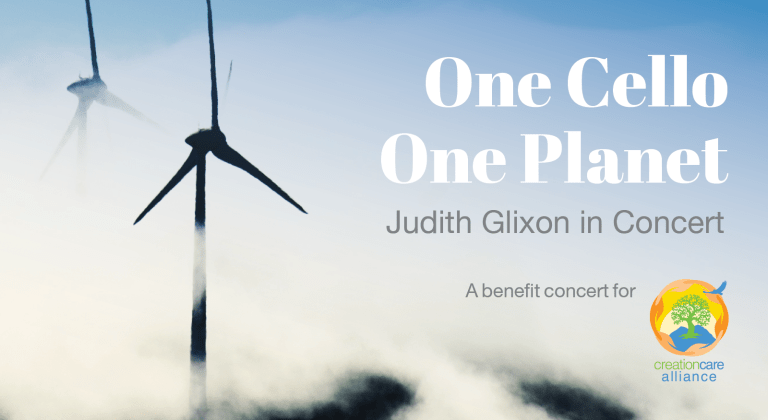
Join us for One Cello, One Planet, a concert that raises awareness for creation care action. Proceeds go to support the work of the Creation Care Alliance, North Carolina Power and Light, and Interfaith Creation Care of the Triangle.

Thursday, August 08, 2019 @ 7:00 PM, Community UCC, 814 Dixie Trl, Raleigh, NC 27607

Judith Glixon, a former Asheville resident and principal cellist with the Asheville Symphony and the Brevard Chamber Orchestra, returns to NC to present a one-hour solo cello concert about the urgency of climate change. The music of J. S. Bach (Unaccompanied Suites #2 & 3), Benjamin Britten (final movement of Suite for Cello, Op.72), Maurice Ravel and a recent composition by Daniel Crawford will take listeners through an abridged history of the human race (with an emphasis on Western civilization) from its beginning until today. Ticket sales for the concert will support the work of Interfaith Creation Care of the Triangle, North Carolina Interfaith Power and Light and the Creation Care Alliance. Interfaith Creation Care of the Triangle works within and across communities of faith to urgently fulfill our sacred duty to love and protect Creation, address our changing climate and ensure justice for all life. NC Interfaith Power & Light, a program of the North Carolina Council of Churches, offers a hope-filled response to the issues of climate change. The Creation Care Alliance focuses on bringing practical and hopeful solutions to our congregations and broader secular communities by engaging hearts and minds through inspiration, education, service, and advocacy.

CLICK HERE FOR TICKETS


Filed Under: Blog, Uncategorized

NCIPL hosts webinar on NC’s Clean Energy Plan

January 11, 2019 By chris

On January 16th, 2019 NC Interfaith Power & Light partnered with NC Governor Cooper’s office to offer a free webinar on Executive Order No. 80, North Carolina’s Commitment to Address […]

NCIPL hosts webinar on NC’s Clean Energy Plan

January 11, 2019 by chris

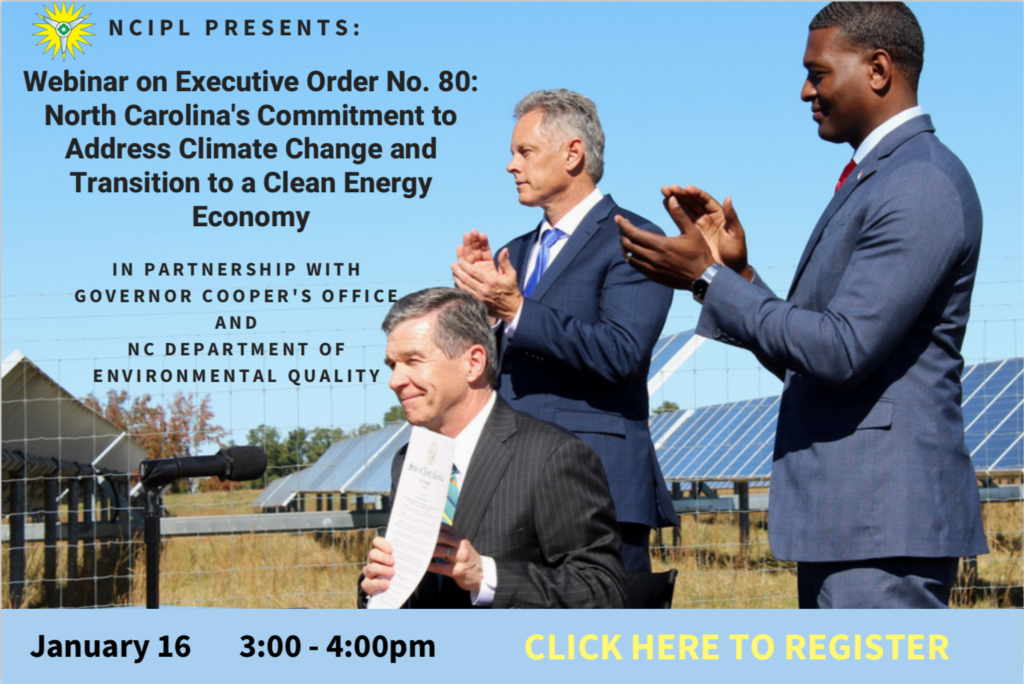
On January 16th, 2019 NC Interfaith Power & Light partnered with NC Governor Cooper’s office to offer a free webinar on Executive Order No. 80, North Carolina’s Commitment to Address Climate Change and Transition to a Clean Energy Economy. Jeremy Tarr, Policy Advisor for the Environment, Energy, and Transportation, and Sushma Masemore, Deputy Assistant Secretary for Environment from the NC Department of Environmental Quality (DEQ) presented the history, plan, and timeline of Executive Order No. 80. Following the presentation was a Q&A session. This event was free and open to the public. We look forward to developing more of these as the governmental agencies leadership on climate action develops.

For more information about the Executive Order click here: https://deq.nc.gov/energy-climate/climate-change/nc-climate-change-interagency-council

Click here for the presentation slides: https://files.nc.gov/ncdeq/climate-change/interagency-council/Climate-Change-Council-Dec-19-2018-Mtg-Powerpoint-FINAL.pdf

Next NC Climate Change Interagency Council Meeting

February 19, 2019 
10:00 a.m. -2:30 p.m.
Museum of the Albemarle 
501 South Water Street
Elizabeth City, NC 27909

Meeting info sheet

Filed Under: Blog, Uncategorized

A Solution for Depleted Soils & Souls

December 5, 2018 By chris

Last Saturday, NCIPL Director Susannah Tuttle and I had the opportunity to attend a conference entitled “Waste Not: Living the Low Carbon Life” in Raleigh. Leaders in the industries of food […]

A Solution for Depleted Soils & Souls

December 5, 2018 by chris

Last Saturday, NCIPL Director Susannah Tuttle and I had the opportunity to attend a conference entitled “Waste Not: Living the Low Carbon Life” in Raleigh. Leaders in the industries of food waste, composting, and soil regeneration gathered with church and community members to discuss the power of composting and reducing food waste. Friends, it was incredible and we left inspired. 

First, we learned that one third of food produced all over the world is wasted, with 40% of food grown in the United States being thrown away. The vast majority of this food ends up in landfills, where it decomposes and contributes to global climate change through significant greenhouse gas emissions.

After confronting these difficult statistics, we were presented with a truly hopeful opportunity. While food waste contributes significantly to global climate change, composting food waste is among the most significant climate solutions that there is! Using compost returns much needed carbon to our depleted soils—and the carbon just keeps coming. Compost continues to sequester carbon from the atmosphere long after it has been applied. In other words, the carbon in our atmosphere isn’t bad: it’s just misplaced. Reducing our food waste, and producing/using compost, all present significant climate solutions!

Noel Lyons, President of McGill Compost, gave the keynote address at Waste Not. He spoke of his company, which focuses on commercial composting, in addition to the connection he has felt to the land since his childhood in Ireland. Then, he gave suggestions regarding how to begin our own composting/waste reduction journey. We’d like to share some of those suggestions with you today:

  1. Compost your food waste at home! This can be done with a small kitchen compost or a larger backyard set-up. If you’re in the Raleigh/Durham or Asheville areas, you can also compost through CompostNow! For the price of 1 cup of coffee a week, the folks at CompostNow will pick up your food scraps and transform them into rich compost. Choose to have the finished product delivered to you for use, or donated to local farmers and organizational partners!
  2. Use compost! It is only by using compost that carbon is returned to the soil, and compost is not just for gardens! Consider spreading compost through your yard, on your church grounds, or at your child’s school. The folks at the NC Composting Council can help with resources and questions.
  3. Educate your friends, family, and faith community about the power of composting! Look to Zero Waste Church for ideas on how to get your faith communities involved.

This Wednesday, December 5th, is World Soil Day. We hope that sometime this week, you have the chance to breathe in the smell of the earth, cup the dirt in your hands, and give thanks. We hope you’ll consider composting in recognition of the world’s soils and their life-giving and regenerative power. We also hope you’ll take some time to learn more about Composting, Regenerative Agriculture, and Food Waste Reduction as solutions to climate change.

We know that climate change impacts the poorest among us most severely. This holiday season, let’s take steps to love our neighbors and all of creation more holistically. Thank God for the soil!


Sarah Ogletree
NCIPL, Sacred Foodscapes Program Intern

Filed Under: Uncategorized

Going Green this Thanksgiving

November 15, 2018 By chris

The food that we consume as a part of the Thanksgiving holiday impacts the health of our climate and our communities. For this reason, we at NCIPL would like to […]

Going Green this Thanksgiving

November 15, 2018 by chris

The food that we consume as a part of the Thanksgiving holiday impacts the health of our climate and our communities. For this reason, we at NCIPL would like to share the following resource from the national office of Interfaith Power & Light (IPL). Many blessings as you gather with your families and friends next week in a spirit of gratitude!
“Today more and more people are concerned about where our food comes from and how eating meat affects the climate. For some people that means becoming vegetarian but for many others it is about making conscious choices about when meat is eaten and where it comes from. They don’t give it up completely but choose to eat a little less meat. And there are many options for choosing local, organic, and humanely raised foods.

Download this report to learn more about how your holiday food choices can benefit the climate.

Factory farms have been shown to be a huge impact on our environment and our climate. According to a report by the Food and Agriculture Organization of the United Nations (FAO), animal agriculture is responsible for 18 percent of all human-induced greenhouse gas emissions, including 37 percent of methane emissions and 65 percent of nitrous oxide emissions. The methane releases from billions of animals on factory farms are 70 times more damaging per ton to the earth’s atmosphere than CO2.

The good thing is now we have many alternatives with a wide range of socially responsible, small-scale farms that produce locally. This alternative produces high-quality food and supports farmers who produce healthy meat, eggs and dairy products using humane methods. You can also choose to add more plant-based items to your meals.

The FAO also reports that currently one-third of the food we produce is either lost or wasted. The global costs of food wastage is in the range of $2.6 trillion a year, including $700 billion of environmental costs & $900 billion of social costs.  Whether we over shop for the meal or never get around to finishing our leftovers many Americans end up having food go bad.

You can learn more about how to reduce your food waste in this kit.

Thanksgiving is a time of year that honors all that we are grateful for. It is a celebration of the bounty provided by the earth… and a holiday where people of all faith traditions can gather their loved ones and be thankful for all we have.  This guide talks about three ways we can celebrate while lowering our carbon footprint. As you plan your Thanksgiving, keep climate in mind.”

Filed Under: Uncategorized

NEWS RELEASE: Eagle Solar & Light Becomes First Solar Energy Lessor in North Carolina

October 16, 2018 By chris

We hope this inspires communities of faith to take advantage of this opportunity to access solar panels without having to put any money down! RALEIGH, NC (October 16, 2018) — On […]

NEWS RELEASE: Eagle Solar & Light Becomes First Solar Energy Lessor in North Carolina

October 16, 2018 by chris

We hope this inspires communities of faith to take advantage of this opportunity to access solar panels without having to put any money down!


RALEIGH, NC (October 16, 2018) — On Monday, the North Carolina Utilities Commission (NCUC) approved Eagle Solar & Light to become the first licensed solar electric generator lessor in North Carolina. The leasing of solar energy facilities is a critical component of the bipartisan House Bill 589, “Competitive Energy Solutions for North Carolina,” which was passed by the NC General Assembly and signed into law by Governor Cooper in July 2017.

While North Carolina has experienced dramatic growth in utility-scale solar over the past decade, it, unfortunately, lags far behind other states in rooftop solar.  HB589 will help meet customers’ demand for rooftop solar by not only allowing leasing but also by offering NC Solar Rebates for some Duke Energy residential, commercial and non-profit customers who install rooftop solar until 2022.

Susannah Tuttle, Director of NC Interfaith Power and Light (NCIPL) remarked on the occasion, “We are relieved that North Carolina finally has a leasing option to help provide opportunities towards meeting demand for rooftop solar power.  I am glad that the General Assembly, our Governor, and many stakeholders recognized the need and am grateful for Eagle Solar & Light taking this first step in being approved by NCUC as an official lessor.”

NCIPL is a program of the North Carolina Council of Churches, comprised of 27 distinct judicatories from 18 denominations with 1.5 million congregants across the state.

Sam Yates, CEO of Eagle Solar and Light, stated that “A fair and transparent lease, coupled with the NC Solar Rebates can be an excellent opportunity for non-profit groups and others to reap both the benefits of solar power.  We look forward to partnering with congregations, community development partners, and others who want to contribute to a greener future”.

Eagle Solar & Light has been active in North Carolina since 2016, and now has offices in Highlands and Chapel Hill.  Eagle Solar & Light is a regional leader in architecturally-advanced, aesthetically-designed solar energy systems and energy saving products that offer long-term economic benefits. For more information please contact Scott Alexander at salexander@eaglesolarandlight.com.

###


Contact info@ncipl.org for more information about how you can go solar today!

Your donations help make all of our work possible. Give Today!

Filed Under: Blog, Uncategorized

NC Council of Churches Pipeline Position

January 29, 2018 By chris

Below is the letter Rev. Dr. Jennifer Copeland, Executive Director of the NC Council of Churches has delivered to Governor Roy Cooper, DEQ Secretary Michael Regan, and NC policy staff. […]

NC Council of Churches Pipeline Position

January 29, 2018 by chris

Below is the letter Rev. Dr. Jennifer Copeland, Executive Director of the NC Council of Churches has delivered to Governor Roy Cooper, DEQ Secretary Michael Regan, and NC policy staff.

Following is contact information for you to take action. You are invited to share this and please amplify NCCC’s Governing Board Policy Statement opposing fracked gas pipelines.

As people of faith, we proclaim our belief that our world is God’s creation, that God sees it as good, and that it is ours to protect and maintain.

May it be so!


January 25, 2018

Friends,

As pressure mounts and decisions are imminent in the Atlantic Coast Pipeline process, I write to share the perspective of the North Carolina Council of Churches, the 18 denominations and 6200 congregations we represent.

It should come as no surprise that we do not look favorably on this pipeline proposal.  Much of what we think can be extrapolated from the Policy Statement opposing fracked gas pipelines since the Atlantic Coast Pipeline will be full of fracked gas. The NC Council of Churches has a long history of standing in the breach for the environment, predating even the landmark Clean Water and Clean Air Acts. Our opposition to this pipeline is consistent with the values we have long held.  So, if you’re looking for some high “moral” ground on which to stand in opposing it, we’re happy to help with that.

Here is part of speech I delivered at a press conference last year opposing the pipeline:

We start with the believers, the believers in climate change, the believers in renewable energy, the believers in environmental justice, the believers in responsible regulation. We work with these people to help us advocate with and educate on behalf of the others. And for my part as the leader of the NC Council of Churches, representing 18 distinct denominations and over 6200 congregations, I start with people of faith.

As people of faith and in my case, the Christian faith, we have a God-given responsibility to care for creation. It is the single greatest gift of the creator to the creatures. Without it, we don’t exist. Without respecting and maintaining the precarious and tender balance that allows life on this planet, we won’t survive. Make no mistake, the creation would be far better off without humans running other creatures into extinction well before their time and devouring plant life at a record pace. Studies have shown the environment will do just fine without us.

So, my appeal for us today is selfish in some ways. I want humans to survive, which means we’ve got to take care of the gift of creation we’ve been given. If we don’t, God and the creation will go on without us. This is a fact, my friends, and we need to start telling people this truth.

I’m a firm believer in the truth. But if I don’t know the truth, then I’m not really choosing between right and wrong, good and bad; I’m just doing what I do without knowing the moral implications of my actions. In blissful ignorance, I continue supporting the disastrous use of fossil fuels by my habits, my investments, and my commitments. But when people know the truth, really know it, then they have to make a choice. When I know that methane — the element that leaks from natural gas pipelines — is 84 times more detrimental to the atmosphere than carbon dioxide, I must make a choice. When I know that fracking — the method used to obtain the natural gas that will flow through this pipeline — causes irreparable damage to drinking water and creates seismic instability, I must make a choice. When I know that pipelines cut through pristine landscapes and across tribal lands, I must make a choice. I can keep doing what I’m doing, for sure, but now I know that what I am doing is an affront to creation, a violation of the gift of creation.  Now I know that what I’m doing is a sin.

We need to tell people this truth. We need to know the truth about the choices we make. May God empower us all to choose life, now and forever more. Thank you.

We hope all of you and Governor Cooper will continue to work diligently to protect the people of North Carolina by protecting the environment they call home.

Best, j

Jennifer E. Copeland, Ph.D.
Executive Director
North Carolina Council of Churches
919-828-6501
http://www.ncchurches.org


Rev. Dr. Jennifer Copeland’s leadership is prophetic and now we must all put our FAITH INTO ACTION to stop this pipeline!

Please make phone calls today in addition to emails and letters. The timing is very critical in the next hours and days.

Blessing upon us all!

Address all requests to Gov. Roy Cooper with copies to the additional officials:

Governor Roy Cooper
Office of the Governor
20301 Mail Service Center
Raleigh, NC 27699-0301

NOTE: To call the Governor and the Governor’s staff, call the Governor’s office request to be connected to the Governor and particular staff listed below:  919-814-2000

Jenny Owen
Director of Policy
Office of the Governor
20301 Mail Service Center
Raleigh, NC 27699-0301
jenni.owen@nc.gov

Sadie Weiner
Director of Communications
Office of the Governor
20301 Mail Service Center
Raleigh, NC 27699-0301
sadie.weiner@nc.gov

Jeremy Tarr
Energy Policy Director
Office of the Governor
20301 Mail Service Center
Raleigh, NC 27699-0301
jeremy.tarr@nc.gov

Secretary Michael S. Regan
N.C. Department of Environmental Quality
217 W. Jones Street
Raleigh, NC 27603
919-707-8622
Michael.Regan@ncdenr.gov

Assistant Secretary Sheila Holman
N.C. Department of Environmental Quality
217 W. Jones Street
Raleigh, NC 27603
919-707-8619
sheila.holman@ncdenr.gov

Director Linda Culpepper
N.C. Division of Water Resources
512 N. Salisbury Street, 7th floor
Raleigh, NC 27604
919-707-9014
linda.culpepper@ncdenr.gov

Dan Hirschman
Senior Deputy Attorney General
114 W. Edenton Street
Raleigh, NC 27603
(919) 716-6600
DHirschman@ncdoj.gov

Blake Thomas
Deputy General Counsel
114 W. Edenton Street
Raleigh, NC 27603
(919) 716-6414
Bthomas@ncdoj.gov

Filed Under: Blog, Uncategorized

  • « Go to Previous Page
  • Page 1
  • Interim pages omitted …
  • Page 4
  • Page 5
  • Page 6
  • Page 7
  • Page 8
  • Interim pages omitted …
  • Page 16
  • Go to Next Page »

Footer

Contact

Eco-Justice Connection
27 Horne St.
Raleigh, NC 27607
(919) 828-6501
info@ncchurches.org

Subscribe

Click here to subscribe to newsletters and blog updates.

  • Facebook
  • Instagram
  • Twitter

Copyright © 2022 Eco-Justice Connection · All Rights Reserved · Website by Tomatillo Design